Category Archives: pets

Entertaining your Puppy on the Cheap

Puppies are expensive. Often times there are adoption fees, vaccinations, vet bills, food, snacks, bedding, training, and so much more, and those are just the essentials! It’s easy to suffer from a little sticker shock when you start adding up the dollars necessary for raising a puppy (but they are so worth it!).

IMG_20140920_152122_resized

When it comes to entertaining your dog with toys and games, it’s easy for that dollar amount to skyrocket. A quick search on PetCO.com revealed toys as expensive as $41.24 (that’s after a 25% discount!), and toys on average sit between $10-15. So stockpiling your dogs toy bin can be quite difficult.

Luckily, there are alternatives! With Pickle, we’ve made some great discoveries about ways to keep her entertained and ways to stimulate her body and her mind. Here are a couple tips and hints about entertaining your puppy on the cheap:

Where to Shop:

Skip the big name stores and go to second-hand stores. Store’s like Marshal’s and Ross are great places to pick up the same puppy toys as Pet Co, but at half the cost (not to mention dishes, leashes, etc)! The fun part is a store like Ross does not track their inventory from store to store, so shopping in their stores is like a scavenger hunt for new goods! Fun for your inner shopper, and a huge payoff to your pup (and your wallet!).

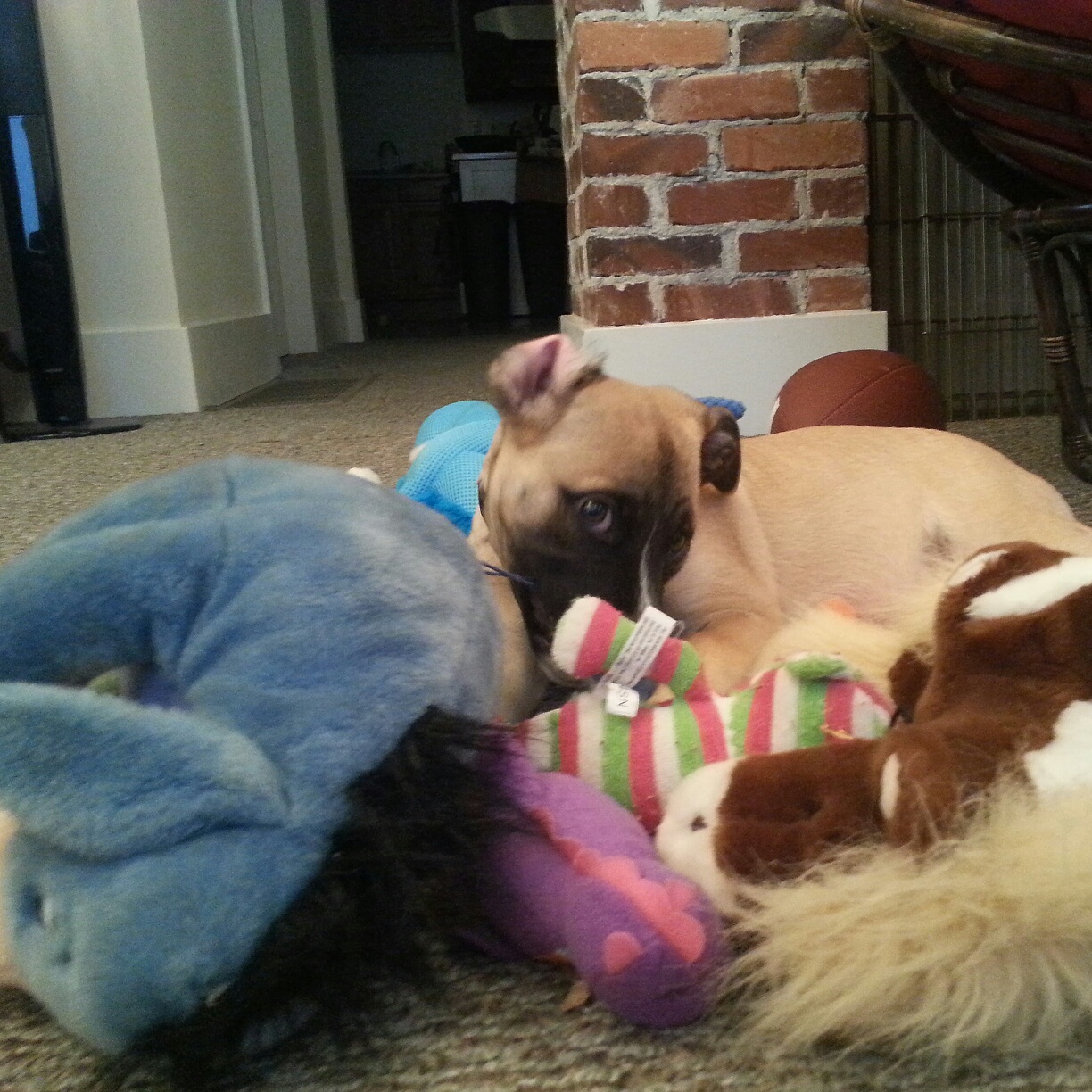
For a little more adventure, we’ve gone toy shopping in Goodwill and thrift stores all across Seattle. Goodwill has a great pet section, sure, but the pay off is finding a fun stuffed animal from the kid’s toy aisle. Kira came back with a stuffed horse and a mopey Eeyore that drove Pickle nuts! I think the smells from these toys cannot be replicated, so it puts her on sensory overload when we play with them. For an added bit of fun, we bought a giant stuffed bear (for $6) that Pickle wrestles with and uses as a dog bed. We ran it through the dryer on high to kill any possible bugs, just in case.

IMG_20141115_114106

Make sure if you are purchasing none dog approved toys from thrift stores that you remove any hard plastic eyes or attachments so your pup doesn’t choke. Also make sure they don’t eat any of the stuffing from inside as it could cause blockage issues. There’s a little extra work needed, but worth it!

In your Home:

Believe it or not, your home is already a great resource for dog toys (if your pup chews on everything, maybe it’s not a surprise). The crunching and texture of a plastic soda bottle mimics the same crunchy texture inside loads of existing dog toys. Before Pickle’s jaws were strong enough to cause problems, we would give her glass bottles that she could nose around the floor (she tried and tried to get the sugary drink from inside the bottle). Any old or torn shirts can be balled and knotted up to create toy ropes. It’s recycling for your dog!

Pro tip: At the bottom of any treat bag is a pile of crumbs. Don’t through them away! I mixed mine with some water and pumpkin puree, and then froze it in an ice-cube tray. Now, whenever Pickle is bothering me in the kitchen, I can toss her a cube and it’ll keep her busy for a couple minutes. Long enough for me to finish cooking dinner.

Mind Games:

We’ve covered toys, what about games? A dogs easily exhausted if they are mentally stimulated, and simple scavenging games can exhaust your pup while buying you a couple minutes to breathe. Our game is quite simple, and quite effective. The set up is simple. Lay some of your pups favorite treats on the ground, then cover it with a blanket. Lay some more treats, add some toys, fold over the blanket, and repeat (as many times as you can). Your dog will have to dig through all the blankets and queue into their scavenging instincts, exerting both physical and mental energy.
IMG_20141031_101806_resized

Your dogs are precious members of the family, and as owners we want to give them everything to ensure they have a happy life. Unfortunately the bill can get out of control before we have time to realize. Luckily, there are simple ways to give your dog lots of joy and entertainment, all it takes is a little creativity in your day. So get out there and spoil your pups!

Have any insider tips on puppy entertainment? Share them on Facebook, Twitter and show off on Instagram!

Bordetella: What it is, and what do I do?

Last week, my girlfriend brought our puppy to her regular puppy play class. She anxiously nosed at the gate, anticipating the fun she was about to have with all of her puppy pals. But then, seemingly out of no where, our puppy Pickle let out a hoarse cough. Immediately, the instructor picked her up and told us we needed to leave. There was no way that a puppy with a cough was going to be allowed to interact with the other pups.

Later that night, as my girlfriend recounted the story to me, I immediately thought the worst. Kennel cough is a common (and potentially serious) illness that effects puppies. However, it is also highly contagious and though the initial illness is not fatal, the symptoms that arise from the puppy being ill could pose health issues.

My background as a boarding kennel assistant had me nervous that we were facing a real serious problem. Not helping matters was the fact that only 48 hours before I had learned that Pickle was treated for kennel cough when she first arrived from Georgia. That night we were on the phone and setting up vet appointments, and the next afternoon, Pickle was getting her physical exam and I was nervously answering health questions (typical first time doctor visit as a parent).

Fast forward 45 minutes, and the vet gave me some reassurance that he didn’t think Pickle had kennel cough. She had some mucus build up in her lungs, but she hadn’t coughed in nearly 12 hours at this point, and that was a good sign. As a precaution he prescribed antibiotics and advised us to isolate Pickle from other dogs (considering we would’ve done that anyway, it was no big shock).

10660212_10152440389061309_5251215736680335950_n

A week later, Pickle has had no sign of a cough and has responded well to the antibiotics (which even cleared up some pesky eye boogers). But the whole experience made me realize how little I (and potentially you as a reader) actually know about kennel cough. So, here’s the skinny:

What is Kennel Cough?*

Kennel cough is the more general term to describe Bordetella, or canine tracheobronchitis. Kennel cough is a highly contagious respiratory illness that leads to inflammation of the trachea and bronchi. Kennel cough usually affects a high percentage of dogs at least one in their lifetime.

Symptoms usually show as heavy, hoarse coughing, dry hacking, and retching. Serious cases could result in a loss of appetite and loss of energy. Puppies, elderly and pregnant dogs are usually at a higher risk due to their compromised immune systems. In severe cases, symptoms progress and can include pneumonia, fever, and even death.

Kennel cough was a term coined to describe the illness due to the frequency of transmission is boarding and shelter facilities. Close proximity of dogs and dirty conditions of unkept shelters or kennels can lead to the fast spread of the illness. But Bordetella can live in water and can be transmitted through shared water dishes, or even simply through physical contact between an infected dog and another dog. Due to its high level of contagiousness, infected dogs are isolated until they can recover.

Kennel cough is diagnosed by a vet, and is conducted based on the symptoms of your dog. Blood tests and urinalysis are run and conclusions are made by the vet.

What do I do if my dog gets Bordetella?

Treatment depends on the severity of the symptoms. If your dog is not showing signs of lethargy, fever or loss of appetite, the illness may be allowed to run its course, much like a human cold. However, if the symptoms prove to be severe, antibiotics and anti-inflammatories will be prescribed. Stay in contact with your vet and be aware of symptoms in case they don’t subside.

Prevention is also possible. The easiest thing is to avoid places where there are high concentrations of dogs. Honestly, though, that’s like teaching abstinence to high schoolers pumped up on hormones. It’s not realistic.

Even if you have never boarded your dog in a kennel, dogs can get kennel cough from shared water sources (think water bowls outside your favorite Starbucks). Interactions with strange dogs on the sidewalk also poses a threat, so avoidance is not realistic.

The best course of action is to seek out a vaccination from your vet. Although not 100% guaranteed, vaccinations would protect your dog from all the real world issues they will inevitably face.

In the end, kennel cough is a potentially serious, yet easily treatable illness in dogs. Though very common and highly contagious, only dogs experiencing severe symptoms (lethargy, fever, etc) face any real threat. Luckily for Pickle the illness has subsided, and luckily for us, kennel cough isn’t contagious to humans. So, despite being sick, there was no interruption in our snuggle time!

* Pet MD, Kennel Cough in Dogs,  http://www.petmd.com/dog/conditions/respiratory/c_dg_canine_tracheobronchitis